
Hilton Head Island History
"We're captivated by the rich history of Hilton Head Island, a tale that's been unfolding for thousands of years. Our journey begins with the island's Native American roots, touches on significant moments such as Spanish and French expeditions of the 16th century, and Captain William Hilton's encounter in 1663. As we explore deeper, the island's pivotal role in the Revolutionary War, its transformation during the Civil War and an intriguing shift from a primarily cotton economy to a thriving vacation and hunting destination are revealed. There's a wealth of knowledge as we investigate further, uncovering the island's path to incorporation, continued growth, and its resolve for preservation and sustainability."
Early Exploration and Settlement
Let's explore the early exploration and settlement of Hilton Head Island, a journey that starts as far back as 2000 B.C. Long before Spanish exploration, Native Americans occupied the Island, creating remarkable shell rings like the Sea Pines Shell ring. Their interaction with the land has left us with protected historical sites, offering an intriguing snapshot into their way of life.
European colonization kicked off with the Spanish expedition led by Francisco Gordillo in 1521. This expedition marked the first European contact with local tribes. The colonists' endeavors continued with the French Huguenots, led by Captain Jean Ribaut, who constructed Fort Ribaut in 1562. However, the Spanish weren't far behind with their settlement of Santa Elena on Parris Island in 1566.
Yet, it was the English who made a lasting impact. Captain William Hilton's 1663 expedition led to the naming of Hilton's Headland. The early English settlement later saw the establishment of plantations, driven by the farming of long-staple cotton by William Elliott II in 1790. This marked the beginning of a significant chapter in the island's history.
Colonial and Revolutionary Era
Building on the rich tapestry of Hilton Head's early exploration and settlement, we now turn our attention to the Colonial and Revolutionary era. The Yamassee conflict in 1715 profoundly impacted Hilton Head Island with violent raids continuing for 15 years, pushing the Indians towards Florida. Amidst this turmoil, the island saw its first white settler, Col. John Barnwell, who received a 1000-acre grant in 1717, marking the start of the Barnwell settlement.
By 1766, the island's population had grown to 25 families, leading to the establishment of St. Luke's Parish in 1767. Interestingly, the island was given its formal name by British explorer William Hilton, who discovered a high bluff of land on the island in 1663, and the island has been known as Hilton Head Island from that point on. The area remained under the influence of both Spanish and English, with the English developing the Low Country.
During the Revolutionary War, the island's heavily taxed indigo planters became patriot sympathizers, forming a stronghold in a largely loyalist region. The island was a hive of tension with frequent British raids and local militia retaliations. Despite the havoc wrought by war, the island rebounded post-war, entering a period of prosperity and innovation. As we explore further into Hilton Head's history, we appreciate the resilience and courage of its early settlers.
Plantation Era Developments
We're now moving to the Plantation Era, a pivotal period in Hilton Head Island history. We'll explore the rise of cotton growth and its impact on the economy, scrutinize the consequences of British invasion, and finally, we'll discuss the liberation of slaves in Mitchelville. These developments played significant roles in shaping the socio-economic landscape of the island. In addition, it is worth noting that the isolation of the island resulted in the preservation of West African dialects and traditions, birthing the distinctive Gullah culture.
Cotton Growth and Economy
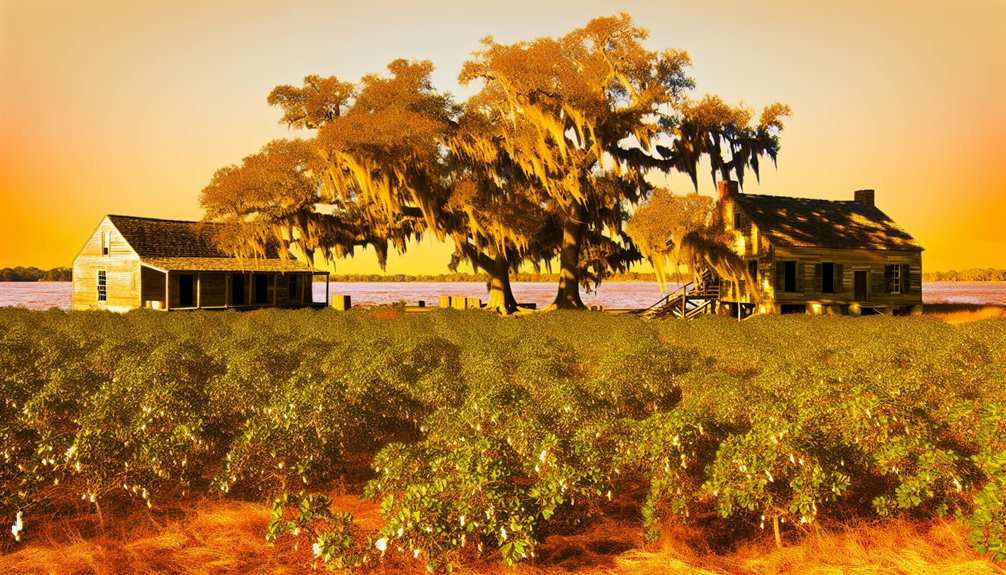
A staggering amount of Sea Island Cotton, distinguished by its extra-long staple fibers, first graced the fertile soils of Hilton Head Island around 1790, marking the initiation of a booming cotton industry. Cotton cultivation became the dominant commercial endeavor as plantations, heavily dependent on slave labor, were established. The economic impact was notable. By 1800, nearly all suitable land was devoted to Sea Island Cotton, which fetched the highest prices in the U.S. market. The invention of the cotton gin further enhanced profitability. An estimated 500 million pounds of this premium cotton were exported from Charleston between 1805 and 1860, primarily to England and New England. This industry was particularly prominent in states such as Georgia and South Carolina where the cultivation and manufacture of cotton were key economic activities (Shilk, Harold W.,1943-). However, this prosperity was not sustainable. The boll weevil infestation between the 1920s and 1930s ended commercial production. Plantations shifted to vacation and hunting lands, laying the groundwork for Hilton Head Island's current status as a resort destination. Today, historical records and relic structures serve as reminders of the sea-island cotton culture. This era, though fraught with challenges, shaped the Island's history and economy to a great extent.
British Invasion Impact
Despite the relative prosperity of Hilton Head Island's plantation era, the Island's history would not be complete without discussing the significant impact of British invasions and raids during the Revolutionary War. British forces targeted the Island's deepwater frontage homes, causing significant social disruptions and economic repercussions. Our plantations, once prosperous with crops like indigo, rice, and cotton, were destroyed, halting our vibrant agricultural production.
The British raids were part of a larger punitive strategy against Patriot sympathizers, aimed at reducing the effectiveness of our local militia. Our resistance, however, was relentless and embodied by our "Bloody Legion," who successfully delayed the British advance, contributing to the larger Patriot victory at Yorktown.
These invasions underscored the strategic importance of Hilton Head, prompting us to bolster our military defenses. The exposure to British naval gunfire led to a strengthening of our coastal defenses, including masonry fortifications and the installation of advanced artillery technology.
The long-term effects of the British invasions and raids shaped Hilton Head's development. Recovery was slow and arduous, with the destruction of our industrial and agricultural sectors hindering growth for decades. Yet, our resilience endured, defining our island's historical identity and leading us into a renewed era of prosperity. Notably, this era was marked by the introduction of the Zalinski Pneumatic Dynamite Gun, a steam-powered artillery piece that changed the face of coastal defense.
Slave Liberation in Mitchelville
In the aftermath of the British invasions, a new chapter emerged in Hilton Head Island's history – the establishment of Mitchelville. Union forces took over the island in 1861, making it a safe haven for escaped slaves from the surrounding areas. By 1862, over 600 freedmen sought refuge here. In September, General Ormsby Mitchel proposed a village for these freedmen, marking the beginning of a unique experiment in community development and Freedmen's rights.
Mitchelville was a model of self-governance, with its own laws, schools, churches, and stores. The residents constructed their own homes using materials provided by the Union Army. They worked for the Union, carrying out tasks like unloading supplies, housekeeping, and working in the commissary, bake shop, garden, and hospital. A mandatory education law guaranteed children attended school, demonstrating the value placed on education.
However, after the Union Army's departure in 1868, Mitchelville's population declined due to a lack of jobs. By the 1880s, it ceased to exist as a formal town. Today, the Mitchelville Preservation Project continues to remember and celebrate this remarkable yet short-lived experiment in Freedmen's rights and community development.
Civil War and Reconstruction Period
With the crack of dawn on November 7, 1861, Hilton Head Island's destiny was forever altered. Over 12,000 Union soldiers and marines landed, capturing Forts Walker and Beauregard within hours, marking the start of the Union occupation. All 24 plantations were soon abandoned, and Union forces claimed them.
This Union occupation wasn't just military; it sparked emancipation efforts, freeing over 1,000 slaves, the first by the Civil War. The island was transformed from a site of slavery to a bustling military hub supporting freedom for ex-slaves. The economy shifted as laborers, now free people, continued work, receiving payment and participating in the community.
Key to the Union's blockade strategy were Forts Sherman, Mitchel, and Howell, controlling access points and defending Mitchelville, a town for emancipated slaves. This new order replaced the Old South, creating a New South with significant cultural and spatial reorganization.
Today, remnants of this period, earthworks and historical markers, offer insight into the island's past. Accessible for self-guided tours, these sites, preserved by organizations like the Heritage Library Foundation and Hilton Head Island Trust, remind us of the island's wartime character, now lost to its identity as a vacation paradise.
Post-Reconstruction to World War II
As we move forward to the next chapter in Hilton Head Island's history, we find the period Post-Reconstruction to World War II brimming with transformative events. We'll explore the early 20th century developments that shaped the Island, the impact of World War II, and the significant progress in logging and infrastructure. This era, often overlooked, is pivotal to understanding the island's evolution from a subsistence economy to a burgeoning tourist destination.
Early 20th Century Developments
Shifting our gaze to the early 20th century, we observe significant changes in Hilton Head Island's land ownership and use. Northerners, including wealthy individuals like William P. Clyde, started buying large amounts of land for exclusive hunting clubs. This trend marked a shift in land use from timbering and hunting to preservation and development.
The island's economy also experienced shifts during this period. Activities such as shipbuilding, cotton production, lumbering, and fishing took precedence. However, due to scarce money, bartering became a common practice among islanders. Land sales to hunting clubs marked another economic shift.
During this era, Hilton Head saw population growth as new inhabitants were attracted by hunting opportunities. The island's community was also shaped by social changes and educational advancements. Influences from earlier communities, like Mitchelville, continued into this period, with compulsory education being a carryover.
Infrastructure development was slow but steady. Electricity arrived in 1951, followed by the first telephone in 1960. In 1956, a bridge was constructed, replacing ferry boats, and marking a significant turning point in the island's accessibility. Overall, this period was characterized by gradual transformation and growth on Hilton Head Island.
World War II Impact
Let's now turn our attention to the period of World War II, a critical epoch in global history. Although Hilton Head Island didn't have a major military presence during the war, the Coast Guard and the Marine Corps used it for military training. Despite the lack of direct involvement in the war, the economic growth in South Carolina due to war efforts indirectly benefited Hilton Head, enhancing its regional economic profile.
The war period also saw the continued cultural preservation of the Gullah culture, with the island's population remaining mostly descendants of former slaves. The community maintained its stability and cultural identity, with traditional livelihoods of small farming, hunting, and fishing persisting.
In terms of post war developments, while there's no significant World War II legacy on Hilton Head, the late 1940s marked a rebirth for the island. Timbermen recognized the potential of the island's tall, straight pines, setting the stage for tourism and development. This period also saw the beginning of Hilton Head's transformation into a resort and residential community, all while preserving much of its natural beauty.
Logging and Infrastructure Advancements
Often overlooked, the logging industry played a pivotal role in Hilton Head Island's economic history. In the 1930s, the timber industry saw a boost when Landon K. Thorne and Alfred L. Loomis purchased nearly 20,000 acres for timber harvesting, building three lumber mills. This industry became a key economic activity for the island, with a population of about 300 residents at the time.
Simultaneously, infrastructure advancements were taking shape. Electricity arrived in 1950, followed by the introduction of a state-operated car ferry in 1953. This, along with the construction of the James F. Byrnes Bridge in 1956, opened the island to automobile traffic, replacing dirt roads with paved ones. These improvements were instrumental in the island's transformation into a resort community.
The first telephone, introduced in 1960, marked another significant infrastructure advancement. Amid these changes, the community continued to grow, with small communities of former slaves thriving through farming, fishing, and other traditional activities. Education saw a boost too, with Hilton Head Elementary School opening its doors in 1954. This period set the stage for the island's evolution into a prosperous tourist destination.
Modern Development and Changes
How fascinating is it that Hilton Head Island, once a quiet and remote location, underwent a significant transformation in the latter half of the 20th century! This transformation began with key infrastructure expansion. Electricity arrived in 1951, and the first telephone in 1960. Dirt roads made way for paved ones, and bridges replaced ferry boats, making the island more accessible.
The most remarkable was the population growth, skyrocketing from a mere 2,500 in 1970 to over 40,000 by 2019. This boom led to the construction of the Island Hospital in 1975, when the population was just 6,500. Today, during peak summer vacations, we see the population surge to a staggering 150,000.
This growth didn't come at the expense of the island's natural beauty, however. Pioneers like Charles Fraser and Fred Hack purchased large tracts of land with an emphasis on preserving the natural environment. The town's Natural Resources Division works diligently to minimize the impact of development, ensuring that even as the island grows, it remains a safe, serene, and beautiful place to live, work, and visit.
Incorporation of Hilton Head Island
In 1983, Hilton Head Island took a significant leap forward by incorporating as a town. This momentous decision was driven by a long campaign for political independence, fueled by dissatisfaction with Beaufort County's control over growth. The island's residents, a diverse mix of retirees and long-term inhabitants, desired local control over development and zoning to guarantee the safety and beauty of their community.
The town adopted a Council-Manager form of government, a structure that allowed the Town Council to set policies and hire a Town Manager to oversee operations. This form of governance provided the town with the local control they yearned for while ensuring efficient management. With this newfound independence, Hilton Head Island could implement stricter land-use, building, and aesthetic requirements.
However, the road to political independence was not without its challenges. African American residents initially opposed incorporation due to fears of limited land development and sale opportunities. Yet, the town remained committed to ethical and inclusive programs, guaranteeing the safety and benefit of all residents. Hilton Head Island's incorporation is a demonstration of the power of local control and the importance of political independence.